Tag: Reflections

  • The Prophet Dialogues-Conversation-I

    The Day of Departure

    “Disclose us to ourselves.”

    GyaniNani and TD

    A note on TD: TD is the one who asks. Younger, unhurried, unwilling to accept a beautiful sentence until it has been tested. Every Nani needs one. TD is also, on most days, the reader.

    TD: Everyone quotes The Prophet for its chapter on children. Why are we beginning somewhere else?

    GyaniNani: Because before Almustafa speaks about children, or love, or freedom, he must first learn to leave.

    TD: Leave what?

    GyaniNani: Everything he has been. Every journey begins with a departure. Every new beginning asks us to set down something we have loved with our whole heart.

    TD: We don’t talk about it that way.

    GyaniNani: No. We celebrate beginnings. We rarely honour the courage of endings.

    TD: One line stayed with me.

    “I cannot withdraw from them without a burden and an ache.”

    Why those words? He is the wise one. Shouldn’t wisdom hurt less?

    GyaniNani: I used to think so. I thought detachment was the goal — that if I loved correctly, leaving would be light.

    I no longer think that.

    The ache is not a failure of wisdom. The ache is the receipt. It is proof that something was real.

    TD: Then what does wisdom change?

    GyaniNani: Not the pain. Only what we do with it. Then he says something more:

    “It is not a garment I cast off this day, but a skin that I tear with my own hands.”

    A garment can be changed.

    A skin has grown into us. It is our identity, our history, sometimes our whole sense of ourselves.

    Life’s deepest transformations are never superficial. They ask us to become someone new.

    TD: That reminds me of childbirth.

    Pregnancy ends. Motherhood begins.

    The ending and the beginning happen in the same moment.

    GyaniNani: And Gibran has a line for exactly that:

    “And shall it be said that my eve was in truth my dawn?”

    Perhaps birth is our first lesson in letting go — for the mother and for the child both.

    Nine months of protecting a child by holding the child within.

    Then one day love asks for the opposite.

    To let go.

    Perhaps every stage of a child’s growth is another small birth.

    The first day at school.

    The first journey alone.

    The first job.

    Marriage.

    Every milestone asks the parent to loosen the grip without loosening the love.

    A question, before we go further.

    What was the last thing you let go of that you are still, quietly, holding? Say it in one line.

    TD: Nani, I want to push back.

    GyaniNani: Please.

    TD: “Loosen the grip without loosening the love” — that is a lovely sentence. But some people let go because they are tired. Some let go and call it wisdom when it was really giving up. How do you tell the difference?

    GyaniNani: You are right, and I do not have a clean answer.

    The only difference I have found is direction. Letting go leaves you facing the other person, still wanting their good. Giving up turns you away.

    But I have not always known which one I was doing at the time. Sometimes I only knew years later.

    TD: So you can get it wrong.

    GyaniNani: Often. That is why this is a conversation and not a lesson.

    TD: Then he asks,

    “Shall the day of parting be the day of gathering?”

    How can parting become gathering?

    GyaniNani: Think of a teacher on her last day.

    People do not come only to say goodbye. They come carrying memories. Gratitude. Stories she had forgotten she was part of.

    Perhaps departures are the days when we finally see the harvest of seeds we sowed without noticing.

    “If this is my day of harvest, in what fields have I sowed the seed, and in what unremembered seasons?”

    TD: Then this one.

    “Am I a harp that the hand of the mighty may touch me, or a flute that his breath may pass through me?”

    Why call himself a harp? Or a flute?

    GyaniNani: Sit with what a flute actually is.

    A flute is a hollow thing.

    It makes music not because it is full, but because it is empty — and because it has been pierced. Every hole in it was made deliberately. Without the wounds, there is no music.

    TD: That is uncomfortable.

    GyaniNani: It is meant to be. This is the most spiritual line in the chapter and it is disguised as a modest question.

    Because it asks two things at once. Can you be emptied? And can you let the breath be someone else’s?

    The flute does not create the music. It permits the music.

    And in the moment of playing, the player and the instrument are not two. Creator and creation become one.

    TD: And that applies where?

    GyaniNani: Everywhere love is real.

    Parents to their children.

    Teachers to their students.

    Friends.

    We are not owners of life. We are lent it, and asked to keep it warm.

    The gardener does not create the seed. Yet the gardener’s love helps it become a tree.

    TD: Gibran asks that too —

    “Shall my heart become a tree heavy-laden with fruit that I may gather and give unto them?”

    GyaniNani: And notice he asks it. He does not declare it.

    He is not certain he has anything to give. On the day everyone gathers to call him wise, he is quietly asking whether he ever was.

    That is the difference between a teacher and a guru.

    TD: There is one line I keep returning to.

    “A noontide have you been in our twilight, and your youth has given us dreams to dream.”

    GyaniNani: That line undoes me a little.

    Because the elders are speaking. And they are telling the young man that he was their light.

    We assume the direction of wisdom. Old to young. Nani to grandchild.

    Gibran reverses it in a single sentence.

    TD: You are supposed to be the Nani here.

    GyaniNani: I know. And most of what I understand, I understood late, and usually because someone younger asked me a question I could not answer.

    Your noontide has fallen on my twilight more than once.

    TD: And the second half of the line?

    GyaniNani: Notice what they do not say.

    They do not say, “You gave us dreams.”

    They say, “You gave us dreams to dream.”

    No one can dream on our behalf. But someone can wake the part of us that is able to dream at all.

    Perhaps the greatest gift we offer another person is not direction.

    It is possibility.

    TD: And then, before asking about love, or children, or work, the people ask him something extraordinary.

    “Disclose us to ourselves.”

    Why that, first?

    GyaniNani: Because they are not asking for answers. They are asking to be seen — and then handed back to themselves.

    That is the whole book, in three words.

    And it is what I hope these eleven conversations become. Not explanations of Gibran.

    Quiet rooms in which we each recognise something we already knew.

    Reflection

    Every departure is an ending and a beginning wearing the same clothes.

    Every birth begins with a letting go.

    Every parent learns, usually the hard way, that love is not possession.

    Every flute is made of holes.

    And every real teacher is a little unsure whether they had anything to give.

    Gibran does not resolve this. He leaves Almustafa standing at the harbour, asking questions.

    So I will not resolve it either.

    The question I am leaving with you:

    What are you calling a garment — that is actually a skin?

    Something you have told yourself you could set down easily. A role. A grief. A version of yourself. A person.

    Answer in one sentence in the comments. Not a paragraph. One sentence is harder, and truer.

    I read every one.

    Until next Friday…

    Conversation II — They Come Through You… Not From You

    Bring the question that has been sitting in you since you first read the chapter on children. That one is going to need all of us.
  • Why The Prophet?

    11 Conversations on parenting, love and letting go

    Inspired by The Prophet by Kahlil Jibran

    A personal Journey

    From a carefree, naive wanderer

    To a lifelong seeker of questions.

    Not because life became easier, but one small book quietly changed the way I looked at the world.

    Walk with us..

    The first conversation begins this friday…

    Welcome to The Prophet Dialogues

  • Beyond the Breaking News-Part 7

    Violence, Fear, Perception and Agency

    Deepali Bhattacharya

    In conversation with TD, Clinical Psychologist  ·  An eleven-part reflection, with notes and references

    PART VII

    Why Old Wounds Never Really Leave

    “Communities remember far longer than newspapers do.”

    There are moments in history that become reference points.

    Ask people where they were during a major earthquake, a terrorist attack or a national tragedy, and many can answer almost instantly.

    Not because they were present.

    But because the event became part of their collective memory. 16

    After the recent train murder, I heard several people say the same thing.

    “It reminded me of 26/11.”

    The comparison was not about numbers.

    It was about emotion.

    When I asked TD why old tragedies return so easily, he explained the idea of collective trauma. 15

    Unlike personal trauma, collective trauma belongs to an entire community. It becomes part of the stories people tell, the fears they inherit and the way future events are interpreted.

    A new incident does not arrive alone.

    It awakens older memories.

    This is true not only for acts of terrorism.

    Communities affected by riots, displacement, recurring floods or long histories of violence often carry invisible emotional maps. A loud sound, a familiar location or even a news headline can reopen emotions that had never completely healed.

    Perhaps this is why healing requires more than time.

    Time passes.

    Memory remains.

    The challenge before society is not to erase painful memories. That is neither possible nor desirable.

    The challenge is to prevent painful memories from becoming permanent prisons.

    Collective memory can become a source of wisdom.

    Or it can become a source of perpetual fear.

    The difference lies in how societies remember.

    Do we remember only the horror?

    Or do we also remember the courage of ordinary people who helped one another?

    History offers both.

    What we choose to pass on matters.

    A QUESTION THAT STAYED WITH ME…

    When does healthy caution quietly become a life governed by fear?

    Notes:

    15.  Erikson (1976), studying the Buffalo Creek flood, first described trauma that damages the tissue of community itself; Hirschberger (2018) reviews how collective trauma becomes part of a group’s identity and meaning-making across generations.

  • Beyond the Breaking News-Part 6

    Violence, Fear, Perception and Agency

    Deepali Bhattacharya

    In conversation with TD, Clinical Psychologist  ·  An eleven-part reflection, with notes and references

    PART VI

    “That Could Have Been Me”

    “Fear is not only about danger. It is about nearness.”

    A few days after the train murder, I found myself listening to conversations in different places. At a café. In a waiting room. During a taxi ride. People were discussing the same incident, but their reactions were strikingly different.

    One young woman who travelled daily by local train admitted that she had barely slept the night after watching the video.

    An elderly gentleman who mostly travelled by car said, “Terrible incident… but these things happen.”

    Neither response was wrong.

    They were simply different.

    When I mentioned this to TD, he smiled.

    “The mind asks only one question before it measures risk,” he said.

    “Could that have been me?”

    Psychologists call this risk perception. Interestingly, our perception of risk is rarely based on statistical probability. It is shaped by familiarity, proximity and imagination. 13

    A commuter who boards the same train every day does not see a random incident. She sees herself standing in that compartment.

    A parent watching news of violence against children imagines their own son or daughter.

    A young bride hearing of another dowry death quietly wonders about her own future.

    Fear becomes personal long before danger becomes probable.

    This is why two people watching the same news bulletin often walk away with entirely different emotions.

    The event is the same.

    The imagination is different.

    Years ago, while interacting with women in rural communities, I noticed something similar. Women routinely described walking long distances before sunrise or after sunset because they had no choice. When I asked whether they were afraid, many replied, “Yes. But we still have to go.”

    Their fear had not disappeared.

    Life had simply left them with fewer alternatives.

    Risk perception is therefore never only psychological. 14

    It is also social.

    Economic circumstances.

    Gender.

    Age.

    Disability.

    Occupation.

    All shape how close danger feels.

    Perhaps this is why public policy must listen not only to crime statistics but also to people’s lived experiences of safety.

    Because people do not live according to probability.

    They live according to perception.

    And perception shapes behaviour.

    A QUESTION THAT STAYED WITH ME…

    If fear grows through imagination, can memory make that fear last long after the event has passed?

    Notes:

    13.  The classic account is Slovic (1987): lay risk perception tracks dread, familiarity and controllability rather than probability. Loewenstein et al. (2001) formalise this as “risk as feelings” — emotional reactions to risk routinely diverge from cognitive assessments and often drive behaviour.

    14.  Kasperson et al. (1988) call this the social amplification of risk: social position, communication channels and institutional response amplify or attenuate how dangerous an event feels to different groups.

  • Beyond the Breaking News-Part 5

    Violence, Fear, Perception and Agency

    Deepali Bhattacharya

    In conversation with TD, Clinical Psychologist  ·  An eleven-part reflection, with notes and references

    PART V

    Fear Is Not the Enemy

    “Before we learn how to overcome fear, we must first stop being ashamed of it.”

    One of the most reassuring moments in my conversation with TD came when I asked him whether people were overreacting.

    His answer surprised me.

    “No,” he said.

    “Fear is survival equipment.” 11

    I have carried that sentence with me ever since.

    We often speak about fear as though it were a weakness.

    Parents tell children not to be afraid.

    Leaders urge people to be fearless.

    Films celebrate those who appear untouched by danger.

    But psychology tells a different story.

    Fear is ancient.

    Long before human beings learnt to build cities or write constitutions, fear kept them alive.

    It warned them of predators.

    It prevented unnecessary risks.

    It prepared the body to respond quickly to danger.

    Without fear, our species would probably not have survived.

    The problem, therefore, is not fear.

    The problem is what happens after fear arrives.

    Some people deny it.

    Some become overwhelmed by it.

    Some quietly organise their lives around avoiding it.

    TD explained something that I found both comforting and practical.

    “The healthiest response,” he said, “is to begin by naming it.”

    “I am afraid.”

    Not because fear deserves control.

    But because unnamed fear often controls us.

    Psychologists have long observed that emotions become easier to regulate once they are acknowledged. 12

    The simple act of recognising fear reduces some of its power.

    Perhaps this explains why conversations matter.

    When people speak honestly about fear, they often discover they are not alone.

    The commuter who hesitates before boarding a train.

    The young woman returning home after work.

    The elderly man living by himself.

    The parents waiting for their child to come home.

    Their fears are different.

    Their humanity is the same.

    The goal is not to become fearless.

    The goal is to prevent fear from becoming the architect of our lives.

    Fear should inform our decisions.

    It should never imprison them.

    A QUESTION THAT STAYED WITH ME…

    If fear is natural, why do some people recover from frightening experiences while others remain trapped by them?

    Perhaps the answer lies in another psychological truth.

    We do not respond only to danger.

    We respond to how close that danger feels to us.

    Notes:

    11.  On fear as evolved protection, see Öhman and Mineka (2001) on the brain’s dedicated “fear module,” shaped by evolutionary threats and designed for rapid, automatic response.

    12.  This is affect labelling: Lieberman et al. (2007) showed that simply putting feelings into words dampens amygdala reactivity — neural evidence that naming an emotion begins to regulate it.

  • From the Founder’s Desk

    From the Founder’s Desk

    Journal Entry #1

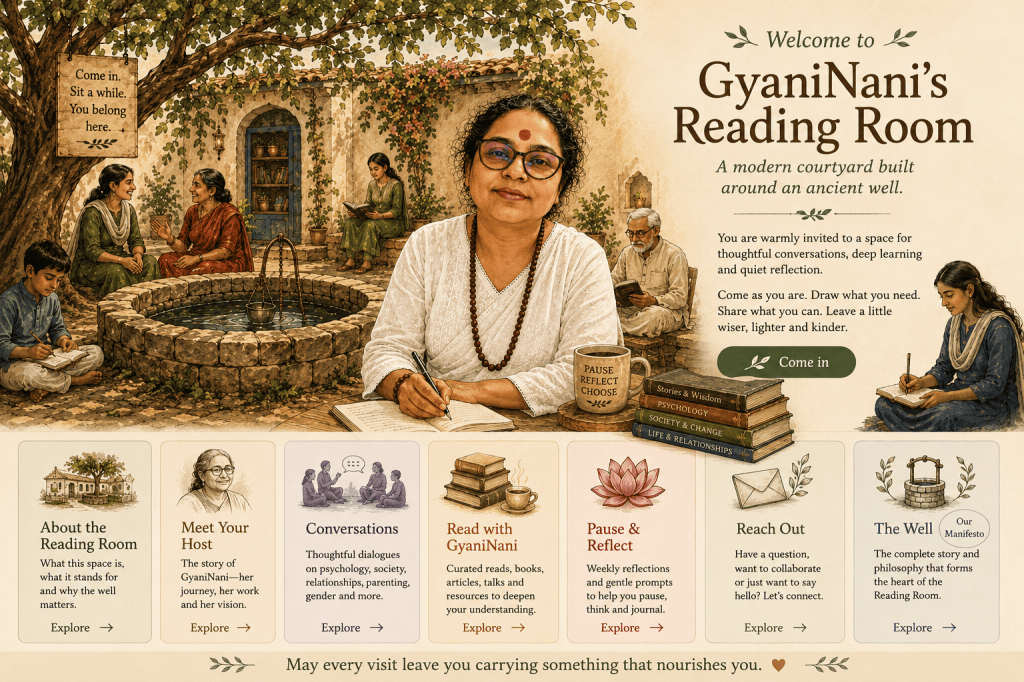
    Opening the Doors to the GyaniNani Reading Room

    1 July 2026

    “We believe that meaningful conversations can change the way we see ourselves, each other, and the world”

    Some dreams arrive quietly.

    Not with applause.
    Not with announcements.
    But with a feeling that refuses to leave.

    For years, I have written reports, research papers, evaluation studies, policy briefs and training manuals. My work has taken me into villages, schools, hospitals, old-age homes, juvenile homes, community centres and government institutions. It has introduced me to extraordinary people whose names may never appear in newspapers but whose courage has transformed the lives of others.

    Wherever I travelled, I returned carrying stories.

    Stories of women rebuilding their lives after violence.
    Stories of children searching for belonging.
    Stories of parents trying to understand their teenagers.
    Stories of farmers protecting seeds for future generations.
    Stories of widows discovering dignity again.
    Stories of hope that quietly survived in the most difficult places.

    I realised that behind every statistic I analysed, there was a human being waiting to be heard.

    Over time, another realisation emerged.

    The world does not suffer from a shortage of information.
    It suffers from a shortage of meaningful conversations.

    We have become skilled at speaking.
    Less skilled at listening.

    Quick to react.
    Slow to reflect.

    Certain of our opinions.
    Less curious about each other’s journeys.

    That is why this Reading Room exists.

    Not as another website.
    Not as another social media page.

    But as a place where conversations are allowed to breathe.

    Here we will explore psychology, parenting, gender, relationships, ageing, mental health, social change, purpose, grief, resilience and the many questions that quietly shape our lives.

    Sometimes the conversation will be with a clinical psychologist.

    Sometimes with a teacher.

    Sometimes with an artist.

    Sometimes with a social worker.

    Sometimes with someone whose voice is rarely heard.

    And sometimes, perhaps, it will simply be a conversation with ourselves.

    One of our first conversations, Beyond the “Trust Fund Kid,” reminded me that before asking what young people are using, perhaps we should ask what they are missing. That single shift—from judgment to curiosity—is the spirit in which this Reading Room has been created.

    I do not promise answers to every question.

    I do promise thoughtful conversations.

    I hope this becomes a place where research meets compassion, where lived experience matters as much as evidence, and where disagreement is welcomed with respect rather than hostility.

    If even one conversation helps someone understand another human being with a little more kindness…
    If one parent pauses before judging…
    If one young person feels less alone…
    If one reader leaves with a question worth carrying…

    Then this Reading Room will have fulfilled its purpose.

    Thank you for walking through these doors.

    Take your time.

    Browse slowly.

    Read deeply.

    Question freely.

    Return often.

    Because wisdom is rarely found in hurried conclusions.
    More often, it grows quietly through conversation.

    The doors are open. Come right in.

    With warmth,

    Deepali Bhattacharya
    Founder, GyaniNani Reading Room

    If this conversation made you pause, it has already begun its work.

    -GyaniNani Reading Room