Tag: Founder’s Journal

  • Beyond the Breaking News-Part 10

    Violence, Fear, Perception and Agency

    Deepali Bhattacharya

    In conversation with TD, Clinical Psychologist  ·  An eleven-part reflection, with notes and references

    PART X

    Kindness Is Not Softness. It Is Prevention.

    “Violence rarely begins with a weapon. More often, it begins with everyday indifference.”

    When people speak about preventing violence, the conversation usually turns towards stricter laws, policing, surveillance or harsher punishments.

    These conversations are important.

    But they often begin too late.

    By the time the law intervenes, someone has already been hurt.

    TD offered another perspective that stayed with me.

    “Kindness,” he said, “is prevention.” 21

    At first, I wondered whether the idea was too simple.

    Then I thought about the people I have met over the years.

    A teacher humiliating a child in front of the class.

    Parents constantly comparing siblings.

    A husband controlling every decision his wife makes.

    Friends laughing at sexist jokes.

    Neighbours choosing silence when they hear repeated screams next door.

    None of these moments make the evening news.

    Yet they quietly shape the emotional climate in which violence either grows or is challenged.

    Violence is rarely born overnight.

    It rehearses itself.

    In language.

    In ridicule.

    In entitlement.

    In humiliation.

    In the belief that some people deserve less dignity than others.

    Perhaps this is why TD insisted that we pay attention to our ordinary conversations.

    Every joke that normalises dowry.

    Every casual remark that blames survivors.

    Every statement that dismisses emotional pain.

    Every act of public humiliation.

    These may appear insignificant.

    They are not.

    Children are always listening.

    Young people are always observing.

    Communities are always learning what is considered acceptable. 22

    If cruelty can be learnt, compassion can also be learnt.

    If disrespect spreads through imitation, so can kindness.

    I often think of development work in the same way.

    Communities do not change only because policies change.

    They change because everyday behaviour changes.

    One respectful conversation.

    One teacher who listens.

    One police officer who responds with dignity.

    One neighbour who chooses to intervene.

    These actions may never become headlines.

    Yet they prevent stories that otherwise might have.

    Perhaps kindness has been misunderstood.

    It is not a weakness.

    It is one of society’s earliest warning systems.

    It notices suffering before statistics do.

    A QUESTION THAT STAYED WITH ME…

    If kindness is prevention, what ultimately gives us the courage to keep choosing it in a world where violence still exists?

    That was the final question I asked TD.

    Notes:

    21.  Public health reaches the same conclusion: the WHO’s World Report on Violence and Health (2002) locates the roots of violence in an ecology of relationships, communities and norms — prevention therefore begins long before law enforcement. On learned aggression, see Bandura (1977).

    22.  WHO (2009) reviews the evidence that changing cultural and social norms — including the everyday speech, jokes and silences that signal acceptability — is a core violence-prevention strategy in its own right.
  • Beyond the Breaking News-Part 9

    Violence, Fear, Perception and Agency

    Deepali Bhattacharya

    In conversation with TD, Clinical Psychologist  ·  An eleven-part reflection, with notes and references

    PART IX

    Agency: The Antidote to Fear

    “Fear tells us what we cannot control. Agency reminds us what we still can.”

    After several conversations on fear, I found myself asking TD a question that many of us quietly ask ourselves after every disturbing news report.

    “What can one ordinary person possibly do?”

    It is an honest question.

    We cannot eliminate violence.

    We cannot predict every danger.

    We cannot control the choices other people make.

    So where does that leave us?

    TD’s answer shifted the conversation in an important way.

    “Psychology uses a simple but powerful word—agency.” 19

    Agency is our ability to recognise that even when circumstances are beyond our control, our response is not.

    Fear narrows our world.

    Agency begins to expand it again.

    It is the difference between saying,

    “The world has become unsafe.”

    And asking,

    “What can I do to become safer?”

    The difference may appear small.

    Psychologically, it is enormous.

    Agency restores something that violence often steals.

    Choice.

    I have seen this repeatedly while working with women rebuilding their lives after violence.

    The turning point rarely arrives through one dramatic event.

    It begins quietly.

    A woman decides to attend a support group.

    Another applies for a job.

    Someone learns self-defence.

    Someone else files a complaint after years of silence.

    Each decision appears ordinary.

    Yet together they represent something extraordinary.

    They mark the return of agency.

    The same principle applies beyond individual lives.

    Communities become stronger when people know one another.

    When neighbours exchange phone numbers.

    When commuters intervene instead of merely recording.

    When schools teach children not only mathematics and science but also empathy, emotional regulation and responsible citizenship.

    Preparedness is not paranoia.

    It is confidence.

    The purpose of preparedness is not to convince ourselves that danger is everywhere.

    It is to reassure ourselves that if danger appears, we are not entirely helpless.

    Perhaps that is why agency is so deeply connected with hope.

    Hope is not wishful thinking.

    Hope is believing that our actions still matter. 20

    A QUESTION THAT STAYED WITH ME…

    If agency helps us respond after violence, what helps prevent violence from taking root in the first place?

    Perhaps the answer lies much closer to home than we imagine.

    Notes:

    19.  Bandura (1997, 2006) places agency and self-efficacy at the centre of psychological functioning: the belief that one’s actions can influence outcomes is among the strongest protections against helplessness.

    20.  This is close to Snyder’s (2002) hope theory, in which hope is not optimism but the combination of goals, pathways and the sense of one’s own capacity to act.

  • From the Founder’s Desk

    From the Founder’s Desk

    Journal Entry #1

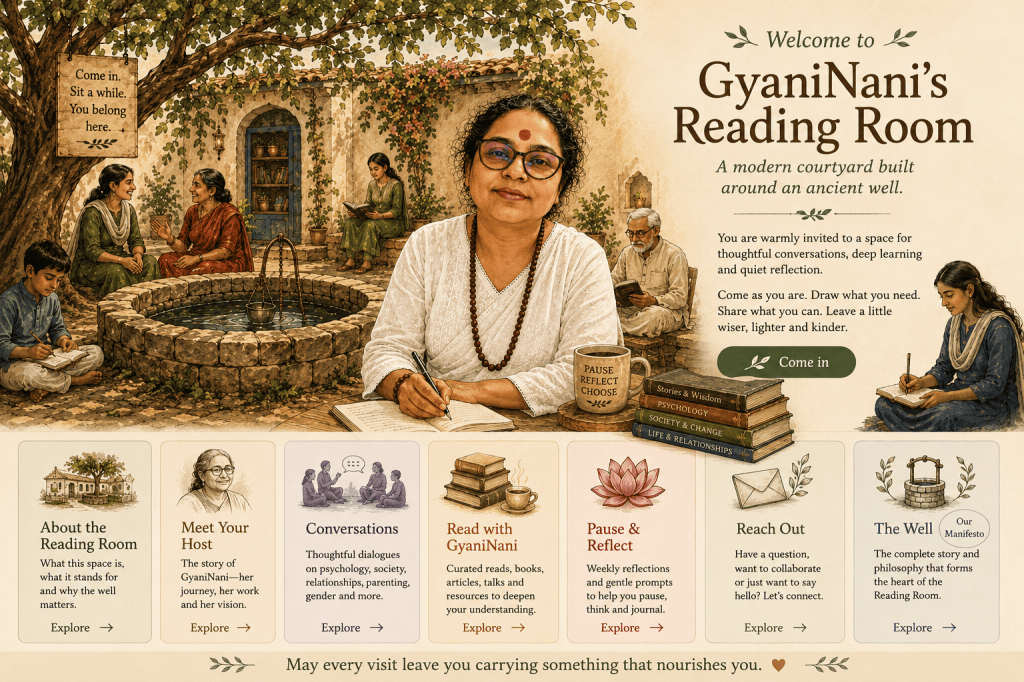
    Opening the Doors to the GyaniNani Reading Room

    1 July 2026

    “We believe that meaningful conversations can change the way we see ourselves, each other, and the world”

    Some dreams arrive quietly.

    Not with applause.
    Not with announcements.
    But with a feeling that refuses to leave.

    For years, I have written reports, research papers, evaluation studies, policy briefs and training manuals. My work has taken me into villages, schools, hospitals, old-age homes, juvenile homes, community centres and government institutions. It has introduced me to extraordinary people whose names may never appear in newspapers but whose courage has transformed the lives of others.

    Wherever I travelled, I returned carrying stories.

    Stories of women rebuilding their lives after violence.
    Stories of children searching for belonging.
    Stories of parents trying to understand their teenagers.
    Stories of farmers protecting seeds for future generations.
    Stories of widows discovering dignity again.
    Stories of hope that quietly survived in the most difficult places.

    I realised that behind every statistic I analysed, there was a human being waiting to be heard.

    Over time, another realisation emerged.

    The world does not suffer from a shortage of information.
    It suffers from a shortage of meaningful conversations.

    We have become skilled at speaking.
    Less skilled at listening.

    Quick to react.
    Slow to reflect.

    Certain of our opinions.
    Less curious about each other’s journeys.

    That is why this Reading Room exists.

    Not as another website.
    Not as another social media page.

    But as a place where conversations are allowed to breathe.

    Here we will explore psychology, parenting, gender, relationships, ageing, mental health, social change, purpose, grief, resilience and the many questions that quietly shape our lives.

    Sometimes the conversation will be with a clinical psychologist.

    Sometimes with a teacher.

    Sometimes with an artist.

    Sometimes with a social worker.

    Sometimes with someone whose voice is rarely heard.

    And sometimes, perhaps, it will simply be a conversation with ourselves.

    One of our first conversations, Beyond the “Trust Fund Kid,” reminded me that before asking what young people are using, perhaps we should ask what they are missing. That single shift—from judgment to curiosity—is the spirit in which this Reading Room has been created.

    I do not promise answers to every question.

    I do promise thoughtful conversations.

    I hope this becomes a place where research meets compassion, where lived experience matters as much as evidence, and where disagreement is welcomed with respect rather than hostility.

    If even one conversation helps someone understand another human being with a little more kindness…
    If one parent pauses before judging…
    If one young person feels less alone…
    If one reader leaves with a question worth carrying…

    Then this Reading Room will have fulfilled its purpose.

    Thank you for walking through these doors.

    Take your time.

    Browse slowly.

    Read deeply.

    Question freely.

    Return often.

    Because wisdom is rarely found in hurried conclusions.
    More often, it grows quietly through conversation.

    The doors are open. Come right in.

    With warmth,

    Deepali Bhattacharya
    Founder, GyaniNani Reading Room

    If this conversation made you pause, it has already begun its work.

    -GyaniNani Reading Room