Tag: everyday-wisdom

  • The Prophet Dialogues- series #001

    The Prophet Dialogues
    Conversation One | The Coming of the Ship

    There were only three of us in our first Prophet Dialogue — Dr. Indu Prakash Singh, Deepali Bhattacharya and Tathagat Dwij.

    We began with The Coming of the Ship, the opening chapter of Kahlil Gibran’s The Prophet. But very soon, we were moving in and out of Gibran — into Kabir and Tennyson, Kafka and Dostoevsky, psychology and philosophy, science and spirituality, and, inevitably, our own lives.
    Maybe that is how The Prophet is meant to be read.
    Not explained. Not analysed line by line. But allowed to take us somewhere.
    We return to books as different people
    There was something deeply personal about beginning these dialogues.
    Nearly thirty years ago, Indu ji introduced Deepali to The Prophet. She has returned to it many times since. Now, after all these years, the two were sitting together again with the same book open before them — this time with Tathagat bringing another generation and another way of seeing to the conversation.
    Indu ji said something that stayed with us. He may have introduced The Prophet to many people over the years, but Deepali had carried it forward and had now brought them back together around it.
    The book was the same.
    We were not.
    And that is probably why an old book can suddenly become new again.
    What do we leave behind when we leave?
    Almustafa has waited twelve years for the ship that will finally take him home. When he sees it, he is filled with joy.
    And sorrow.
    That contradiction drew us in.
    Indu ji stopped at Gibran’s image of Almustafa leaving “fragments of the spirit” in the streets of Orphalese.
    Can we ever really leave a place where we have lived deeply? Or a relationship? Or even a particular time in our lives?
    We move on, but some part of us remains.
    And some part of what we leave behind travels with us.
    Almustafa wants to go home. His sadness does not make that desire less real. It simply tells us that departure and attachment can exist together.
    Leaving does not mean we have stopped loving.
    What happens when it becomes quiet?
    Then came Gibran’s “seeker of silences.”
    Tathagat stopped there.
    He looked at silence through psychology. When the outside noise disappears — sounds, images, conversations, distractions — the mind begins to encounter itself. Thoughts start churning. Sometimes something emerges from that silence: an insight, an understanding, even an epiphany.
    But he added a caution.
    Just because a thought feels profound does not make it true.
    We can become intoxicated by our own thinking. We can build explanations about ourselves and the world and then start treating those explanations as reality.
    That is where the seeker has to be careful.
    The conversation moved naturally from here to Kafka’s Letter to His Father, Dostoevsky and existential thought — to the uncomfortable inner territories of fear, guilt, freedom, relationships, alienation and self-deception.
    And suddenly The Prophet did not feel like a “spiritual book” at all.
    It felt like a poetic way of entering some of the hardest emotional questions of being human.
    The lantern is mine. The flame is not.
    Indu ji kept returning to Almustafa’s humility.
    After all his years of contemplation, Almustafa still does not say: I possess wisdom.
    Instead, Gibran gives us the image of the lantern.
    The lantern may be mine. The flame is not.
    That changes the meaning of knowledge.
    We may carry it. We may give it a form. But can we really claim to be its source?
    Then came another image — the harp and the flute.
    And from Gibran, the conversation travelled to Kabir.
    Deepali remembered the imagery of Kabir’s Nirgun tradition, where the human body itself becomes a dwelling, a fort, containing within it different centres of life and consciousness — awake in some places, sleeping in others. The body is not simply a physical shell. It is through this body that we experience life and seek a connection with something beyond ourselves.
    That made Gibran’s flute feel strangely familiar.
    A flute has a body. It has openings. It has form.
    But there is no music until breath passes through it.
    So what are we?
    The music?
    The flute?
    The breath?
    We did not try to settle the question.
    That was the beauty of it.
    How can a drop be boundless?
    Then Indu ji stopped us at one extraordinary phrase:
    “A boundless drop to a boundless ocean.”
    The ocean being boundless is easy enough to imagine.
    But the drop?
    How can a drop be boundless?
    Indu ji brought in the idea of purna — the whole, the complete. If the drop comes from the whole, can it ever be entirely separate from it?
    Deepali responded from science.
    Think of a single cell in the human body.
    Compared with the whole body, it is almost unimaginably small. Yet a nucleated cell carries genetic information associated with the whole organism. It is only one cell; it is certainly not the entire human being. And yet something of the blueprint of the whole is held within that tiny unit.
    That offered another way of thinking about Gibran’s drop.
    A drop does not become the ocean merely because it came from it. And yet the nature of the ocean is present in that drop.
    Maybe our smallness and our connection to something larger are not contradictions after all.
    We are the drop.
    We are part of the ocean.
    And something of the ocean is within us.
    Science and spirituality were not being used to prove each other. They simply gave us two different languages with which to wonder about the same thing.
    And then Indu ji picked up an old schoolbook…
    One of the loveliest moments of the conversation came almost casually.
    Indu ji reached for an old Class IX book — a 1975 edition — and read Tennyson to us.
    There was something wonderful about it.
    A poem sitting inside a schoolbook for more than fifty years suddenly entered a conversation in 2026 about Gibran.
    And around the same table were Kabir, Tennyson, Kafka and Dostoevsky.
    Not because we had planned an impressive list of writers to discuss.
    One thought simply led to another.
    That is what good conversations do.
    “You have given us dreams to dream”
    This was one of the lines that held Deepali.
    What an extraordinary thing to say to another human being:
    You gave us dreams to dream.
    Sometimes a person enters our life and does not give us anything tangible.
    They simply make possibility visible again.
    Their energy, ideas, questions or way of looking at life awaken something that had become quiet inside us.
    Maybe this is what mentors do too.
    They do not hand us our dreams.
    They help us discover that we can still dream.
    “Disclose us to ourselves”
    Towards the end, we came to the line that stayed with all three of us in different ways.
    The people of Orphalese do not simply ask Almustafa to tell them what he knows.
    They ask him to “disclose us to ourselves.”
    Tathagat brought us back to psychology.
    To see ourselves requires honesty. Not the version of ourselves we present to other people, but the stories we tell ourselves when nobody else is listening.
    We can deceive other people.
    The more dangerous deception begins when we start deceiving ourselves.
    And suddenly this line connected with so much of what we had already discussed.
    The seeker of silence.
    The lantern and its flame.
    The flute and the breath.
    The drop and the ocean.
    Maybe the Prophet is not there to fill people with his wisdom.
    Maybe he is there to help them recognise something that is already within them.
    And that may also explain why three people could sit with the same chapter and find three different doors opening.
    One came through philosophy and spirituality.
    One through lived experience, Kabir and science.
    One through psychology and existential thought.
    None cancelled the other.
    They made the room larger.
    That, more than anything, was our first Prophet Dialogue.
    We began with one chapter.
    We ended up talking about leaving and belonging, silence and thought, knowledge and humility, the body and the divine, the individual and the infinite, teachers, dreams and the difficult business of knowing ourselves.
    There were no conclusions as we have just arrived at the port waiting to jump in.
    In fact, there is no need to conclude too for our conversation has begun.

    The Prophet Dialogues
    Three readers. Different ways of seeing. One conversation that continues.


  • THE THOUGHT PAN CONVERSATIONS — #1

    When Does Freedom Become Agency?


    An Independence Day reflection on women, empowerment and the things we sometimes count too quickly.

    Happy Independence Day.

    Today, as we celebrate freedom, I find myself thinking about a word that we use very easily in the development sector:

    Empowerment.

    For decades, I have heard—and probably used myself—sentences such as:

    We empowered 500 women.

    The programme empowered women economically.

    Women were empowered through Self-Help Groups.

    And somewhere along the way, I began to feel uncomfortable with this language.

    Can I really empower another woman?

    Can an organisation empower her?

    Can a project?

    Or is empowerment something that happens when the conditions around a woman change sufficiently for her own agency to expand?

    That distinction may sound like semantics.

    I don’t think it is.

    Put it in the Thought Pan

    Consider a woman who has started earning ₹5,000 every month.

    Our programme data may record her as economically empowered.

    But suppose she cannot decide how that ₹5,000 will be spent.

    What exactly has changed?

    Now consider another woman who has joined a Self-Help Group. She attends every meeting. Her attendance is excellent. She participates in training programmes.

    But at home, she still cannot decide whether she can visit the health centre, travel to the market, buy something for herself or allow her daughter to continue her education.

    What exactly have we measured?

    Or consider the woman whose name appears proudly against the indicator:

    “Women with access to formal banking.”

    She has a bank account.

    But her husband keeps the passbook.

    Someone else knows the PIN.

    Someone else decides when money is withdrawn.

    She has access.

    Does she have control?

    Participation is not agency

    This is where development language sometimes gets ahead of lived reality.

    We count women who attended.

    Women who received.

    Women who enrolled.

    Women who opened accounts.

    Women who were trained.

    Women who received livelihood assets.

    Women who became members of committees.

    All of these matter. They may be important first steps.

    But they are not necessarily evidence of agency.

    Because participation is not agency.

    Access is not control.

    And an output is not necessarily a change.

    A livelihood asset may enter a household without changing who makes decisions.

    A bank account may be opened without changing financial power.

    A woman may sit on a village committee without anyone listening when she speaks.

    And sometimes a programme can improve a woman’s income while leaving her control over her time, mobility and choices almost untouched.

    This is precisely why numbers alone have never been enough for an evaluator.

    The number tells us what happened.

    We still need to ask why, how—and for whom did it actually change something?

    So what can programmes do?

    Perhaps we need to become a little more modest about our role as evaluators.

    We cannot give another human being agency.

    But we can help create the conditions in which agency becomes possible.

    We can create access.

    We can remove barriers.

    We can redistribute resources and opportunities.

    We can create safe spaces for women to organise.

    We can strengthen knowledge and skills.

    We can challenge discriminatory institutions.

    We can make systems listen.

    We can ensure that women have information, networks, resources and choices that were previously denied to them.

    And then something important can begin to happen.

    A woman decides.

    A woman negotiates.

    A woman refuses.

    A woman chooses.

    A woman speaks—and expects to be heard.

    Perhaps that is where empowerment begins.

    Freedom from. Freedom to.

    On Independence Day, this distinction feels particularly important.

    Freedom is not only freedom from something.

    It is also freedom to.

    Freedom to choose.

    Freedom to speak.

    Freedom to earn—and decide.

    Freedom to move.

    Freedom to participate—and influence.

    Freedom to aspire.

    Freedom to say yes.

    And, equally importantly, freedom to say no.

    For women, perhaps the real question is therefore not simply:

    “Has she been included?”

    But:

    “Has her universe of choices expanded?”

    And even more importantly:

    “Can she act upon those choices?”

    That is a much harder thing to measure.

    But perhaps it is also the thing most worth measuring.


    Something to keep stirring

    This Independence Day, I am leaving one question in the Thought Pan:

    «If a woman participates in development but does not gain greater control over the decisions that shape her life, can we really call it empowerment?»

    I don’t have a neat answer.

    That is precisely why it belongs here.

    Some ideas need to be cooked slowly.

    Tested carefully.

    Questioned repeatedly.

    And shared freely.

    Happy Independence Day.

    May our understanding of freedom continue to deepen—not only as independence, but as the everyday ability of every person to exercise choice, voice and agency.

    Shift in language. Shift in mindset.


    THE THOUGHT PAN CONVERSATIONS

    Cooking ideas slowly. Testing them carefully. Serving them freely.

    Every Saturday, we put one familiar idea back into the pan—and see what happens when we stir it again.

  • Letter to Mai on Guru Purnima

    My eternal love

    Dear Mai,

    Before the day of Guru Purnima comes to an end, I wanted to write you a letter. Strangely, this is the first letter I have ever written to you. I never really needed to write one—you were always there with me. And even when you were not physically beside me, you were just a phone call away.

    I miss you, Mai.

    You were the one I loved with all my heart. But saying “you loved me” is not enough. A mother’s love cannot be measured in words. It is eternal, unconditional, and perhaps the purest form of love that exists.

    From my childhood, I somehow always felt that I had to protect you, that I had to live for you. You were so vulnerable and so innocent at times. You were an ambitious young woman whose dreams were crushed—first by your parental family and then by your marital family.

    I often marvelled at your resilience, but I also struggled with the fact that you never stood up for yourself. Perhaps no one had ever taught you how. Yet, despite that, you taught us something even more valuable—to withstand pressure, to remain strong, and to follow our dreams.

    Today is the first Guru Purnima when I cannot touch your feet. You are my first Guru. Distance, time, and even death cannot change that.

    I still remember the last Guru Purnima in the hospital. You were so unwell. I don’t know whether I was being insensitive or simply trying to prepare myself when I said, “Mom, let me offer my last pranam to you.” And you quietly replied, “My last blessing to you. Everything comes to an end. Nothing is stagnant.”

    Mai… I have carried those words in my heart ever since.

    Did I, in some way, push you to leave this world by saying that?

    I don’t know why this thought keeps haunting me.

    I am sorry, Mom.

    I love you. And I miss you far more than words can ever express.

    I am still trying to figure out what life is without you. My life revolved around you—our countless conversations, those little phone calls every now and then, asking each other the smallest things. It has been a year now without hearing your voice. I still cannot believe that life has somehow continued.

    But believe me, a part of me left with you forever.

    However hard I try, I know I will never be the same person again.

    On this Guru Purnima, I bow my head before my first Guru—my Mai.

    Jai Guru, Mummy!!

    Your Deepu, always.

  • The Prophet Dialogues-Conversation-I

    The Day of Departure

    “Disclose us to ourselves.”

    GyaniNani and TD

    A note on TD: TD is the one who asks. Younger, unhurried, unwilling to accept a beautiful sentence until it has been tested. Every Nani needs one. TD is also, on most days, the reader.

    TD: Everyone quotes The Prophet for its chapter on children. Why are we beginning somewhere else?

    GyaniNani: Because before Almustafa speaks about children, or love, or freedom, he must first learn to leave.

    TD: Leave what?

    GyaniNani: Everything he has been. Every journey begins with a departure. Every new beginning asks us to set down something we have loved with our whole heart.

    TD: We don’t talk about it that way.

    GyaniNani: No. We celebrate beginnings. We rarely honour the courage of endings.

    TD: One line stayed with me.

    “I cannot withdraw from them without a burden and an ache.”

    Why those words? He is the wise one. Shouldn’t wisdom hurt less?

    GyaniNani: I used to think so. I thought detachment was the goal — that if I loved correctly, leaving would be light.

    I no longer think that.

    The ache is not a failure of wisdom. The ache is the receipt. It is proof that something was real.

    TD: Then what does wisdom change?

    GyaniNani: Not the pain. Only what we do with it. Then he says something more:

    “It is not a garment I cast off this day, but a skin that I tear with my own hands.”

    A garment can be changed.

    A skin has grown into us. It is our identity, our history, sometimes our whole sense of ourselves.

    Life’s deepest transformations are never superficial. They ask us to become someone new.

    TD: That reminds me of childbirth.

    Pregnancy ends. Motherhood begins.

    The ending and the beginning happen in the same moment.

    GyaniNani: And Gibran has a line for exactly that:

    “And shall it be said that my eve was in truth my dawn?”

    Perhaps birth is our first lesson in letting go — for the mother and for the child both.

    Nine months of protecting a child by holding the child within.

    Then one day love asks for the opposite.

    To let go.

    Perhaps every stage of a child’s growth is another small birth.

    The first day at school.

    The first journey alone.

    The first job.

    Marriage.

    Every milestone asks the parent to loosen the grip without loosening the love.

    A question, before we go further.

    What was the last thing you let go of that you are still, quietly, holding? Say it in one line.

    TD: Nani, I want to push back.

    GyaniNani: Please.

    TD: “Loosen the grip without loosening the love” — that is a lovely sentence. But some people let go because they are tired. Some let go and call it wisdom when it was really giving up. How do you tell the difference?

    GyaniNani: You are right, and I do not have a clean answer.

    The only difference I have found is direction. Letting go leaves you facing the other person, still wanting their good. Giving up turns you away.

    But I have not always known which one I was doing at the time. Sometimes I only knew years later.

    TD: So you can get it wrong.

    GyaniNani: Often. That is why this is a conversation and not a lesson.

    TD: Then he asks,

    “Shall the day of parting be the day of gathering?”

    How can parting become gathering?

    GyaniNani: Think of a teacher on her last day.

    People do not come only to say goodbye. They come carrying memories. Gratitude. Stories she had forgotten she was part of.

    Perhaps departures are the days when we finally see the harvest of seeds we sowed without noticing.

    “If this is my day of harvest, in what fields have I sowed the seed, and in what unremembered seasons?”

    TD: Then this one.

    “Am I a harp that the hand of the mighty may touch me, or a flute that his breath may pass through me?”

    Why call himself a harp? Or a flute?

    GyaniNani: Sit with what a flute actually is.

    A flute is a hollow thing.

    It makes music not because it is full, but because it is empty — and because it has been pierced. Every hole in it was made deliberately. Without the wounds, there is no music.

    TD: That is uncomfortable.

    GyaniNani: It is meant to be. This is the most spiritual line in the chapter and it is disguised as a modest question.

    Because it asks two things at once. Can you be emptied? And can you let the breath be someone else’s?

    The flute does not create the music. It permits the music.

    And in the moment of playing, the player and the instrument are not two. Creator and creation become one.

    TD: And that applies where?

    GyaniNani: Everywhere love is real.

    Parents to their children.

    Teachers to their students.

    Friends.

    We are not owners of life. We are lent it, and asked to keep it warm.

    The gardener does not create the seed. Yet the gardener’s love helps it become a tree.

    TD: Gibran asks that too —

    “Shall my heart become a tree heavy-laden with fruit that I may gather and give unto them?”

    GyaniNani: And notice he asks it. He does not declare it.

    He is not certain he has anything to give. On the day everyone gathers to call him wise, he is quietly asking whether he ever was.

    That is the difference between a teacher and a guru.

    TD: There is one line I keep returning to.

    “A noontide have you been in our twilight, and your youth has given us dreams to dream.”

    GyaniNani: That line undoes me a little.

    Because the elders are speaking. And they are telling the young man that he was their light.

    We assume the direction of wisdom. Old to young. Nani to grandchild.

    Gibran reverses it in a single sentence.

    TD: You are supposed to be the Nani here.

    GyaniNani: I know. And most of what I understand, I understood late, and usually because someone younger asked me a question I could not answer.

    Your noontide has fallen on my twilight more than once.

    TD: And the second half of the line?

    GyaniNani: Notice what they do not say.

    They do not say, “You gave us dreams.”

    They say, “You gave us dreams to dream.”

    No one can dream on our behalf. But someone can wake the part of us that is able to dream at all.

    Perhaps the greatest gift we offer another person is not direction.

    It is possibility.

    TD: And then, before asking about love, or children, or work, the people ask him something extraordinary.

    “Disclose us to ourselves.”

    Why that, first?

    GyaniNani: Because they are not asking for answers. They are asking to be seen — and then handed back to themselves.

    That is the whole book, in three words.

    And it is what I hope these eleven conversations become. Not explanations of Gibran.

    Quiet rooms in which we each recognise something we already knew.

    Reflection

    Every departure is an ending and a beginning wearing the same clothes.

    Every birth begins with a letting go.

    Every parent learns, usually the hard way, that love is not possession.

    Every flute is made of holes.

    And every real teacher is a little unsure whether they had anything to give.

    Gibran does not resolve this. He leaves Almustafa standing at the harbour, asking questions.

    So I will not resolve it either.

    The question I am leaving with you:

    What are you calling a garment — that is actually a skin?

    Something you have told yourself you could set down easily. A role. A grief. A version of yourself. A person.

    Answer in one sentence in the comments. Not a paragraph. One sentence is harder, and truer.

    I read every one.

    Until next Friday…

    Conversation II — They Come Through You… Not From You

    Bring the question that has been sitting in you since you first read the chapter on children. That one is going to need all of us.

  • Beyond the Breaking News-Part 5

    Violence, Fear, Perception and Agency

    Deepali Bhattacharya

    In conversation with TD, Clinical Psychologist  ·  An eleven-part reflection, with notes and references

    PART V

    Fear Is Not the Enemy

    “Before we learn how to overcome fear, we must first stop being ashamed of it.”

    One of the most reassuring moments in my conversation with TD came when I asked him whether people were overreacting.

    His answer surprised me.

    “No,” he said.

    “Fear is survival equipment.” 11

    I have carried that sentence with me ever since.

    We often speak about fear as though it were a weakness.

    Parents tell children not to be afraid.

    Leaders urge people to be fearless.

    Films celebrate those who appear untouched by danger.

    But psychology tells a different story.

    Fear is ancient.

    Long before human beings learnt to build cities or write constitutions, fear kept them alive.

    It warned them of predators.

    It prevented unnecessary risks.

    It prepared the body to respond quickly to danger.

    Without fear, our species would probably not have survived.

    The problem, therefore, is not fear.

    The problem is what happens after fear arrives.

    Some people deny it.

    Some become overwhelmed by it.

    Some quietly organise their lives around avoiding it.

    TD explained something that I found both comforting and practical.

    “The healthiest response,” he said, “is to begin by naming it.”

    “I am afraid.”

    Not because fear deserves control.

    But because unnamed fear often controls us.

    Psychologists have long observed that emotions become easier to regulate once they are acknowledged. 12

    The simple act of recognising fear reduces some of its power.

    Perhaps this explains why conversations matter.

    When people speak honestly about fear, they often discover they are not alone.

    The commuter who hesitates before boarding a train.

    The young woman returning home after work.

    The elderly man living by himself.

    The parents waiting for their child to come home.

    Their fears are different.

    Their humanity is the same.

    The goal is not to become fearless.

    The goal is to prevent fear from becoming the architect of our lives.

    Fear should inform our decisions.

    It should never imprison them.

    A QUESTION THAT STAYED WITH ME…

    If fear is natural, why do some people recover from frightening experiences while others remain trapped by them?

    Perhaps the answer lies in another psychological truth.

    We do not respond only to danger.

    We respond to how close that danger feels to us.

    Notes:

    11.  On fear as evolved protection, see Öhman and Mineka (2001) on the brain’s dedicated “fear module,” shaped by evolutionary threats and designed for rapid, automatic response.

    12.  This is affect labelling: Lieberman et al. (2007) showed that simply putting feelings into words dampens amygdala reactivity — neural evidence that naming an emotion begins to regulate it.

  • From the Founder’s Desk

    From the Founder’s Desk

    Journal Entry #1

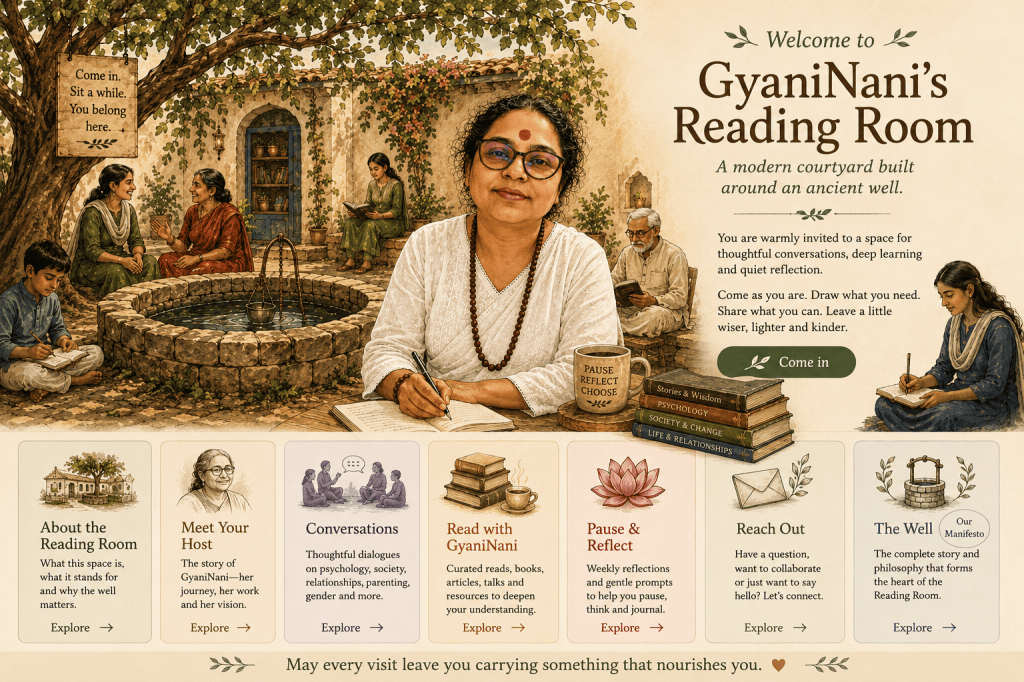
    Opening the Doors to the GyaniNani Reading Room

    1 July 2026

    “We believe that meaningful conversations can change the way we see ourselves, each other, and the world”

    Some dreams arrive quietly.

    Not with applause.
    Not with announcements.
    But with a feeling that refuses to leave.

    For years, I have written reports, research papers, evaluation studies, policy briefs and training manuals. My work has taken me into villages, schools, hospitals, old-age homes, juvenile homes, community centres and government institutions. It has introduced me to extraordinary people whose names may never appear in newspapers but whose courage has transformed the lives of others.

    Wherever I travelled, I returned carrying stories.

    Stories of women rebuilding their lives after violence.
    Stories of children searching for belonging.
    Stories of parents trying to understand their teenagers.
    Stories of farmers protecting seeds for future generations.
    Stories of widows discovering dignity again.
    Stories of hope that quietly survived in the most difficult places.

    I realised that behind every statistic I analysed, there was a human being waiting to be heard.

    Over time, another realisation emerged.

    The world does not suffer from a shortage of information.
    It suffers from a shortage of meaningful conversations.

    We have become skilled at speaking.
    Less skilled at listening.

    Quick to react.
    Slow to reflect.

    Certain of our opinions.
    Less curious about each other’s journeys.

    That is why this Reading Room exists.

    Not as another website.
    Not as another social media page.

    But as a place where conversations are allowed to breathe.

    Here we will explore psychology, parenting, gender, relationships, ageing, mental health, social change, purpose, grief, resilience and the many questions that quietly shape our lives.

    Sometimes the conversation will be with a clinical psychologist.

    Sometimes with a teacher.

    Sometimes with an artist.

    Sometimes with a social worker.

    Sometimes with someone whose voice is rarely heard.

    And sometimes, perhaps, it will simply be a conversation with ourselves.

    One of our first conversations, Beyond the “Trust Fund Kid,” reminded me that before asking what young people are using, perhaps we should ask what they are missing. That single shift—from judgment to curiosity—is the spirit in which this Reading Room has been created.

    I do not promise answers to every question.

    I do promise thoughtful conversations.

    I hope this becomes a place where research meets compassion, where lived experience matters as much as evidence, and where disagreement is welcomed with respect rather than hostility.

    If even one conversation helps someone understand another human being with a little more kindness…
    If one parent pauses before judging…
    If one young person feels less alone…
    If one reader leaves with a question worth carrying…

    Then this Reading Room will have fulfilled its purpose.

    Thank you for walking through these doors.

    Take your time.

    Browse slowly.

    Read deeply.

    Question freely.

    Return often.

    Because wisdom is rarely found in hurried conclusions.
    More often, it grows quietly through conversation.

    The doors are open. Come right in.

    With warmth,

    Deepali Bhattacharya
    Founder, GyaniNani Reading Room

    If this conversation made you pause, it has already begun its work.

    -GyaniNani Reading Room