Tag: deepali-bhattacharya

  • Beyond the Breaking News-Part 5

    Violence, Fear, Perception and Agency

    Deepali Bhattacharya

    In conversation with TD, Clinical Psychologist  ·  An eleven-part reflection, with notes and references

    PART V

    Fear Is Not the Enemy

    “Before we learn how to overcome fear, we must first stop being ashamed of it.”

    One of the most reassuring moments in my conversation with TD came when I asked him whether people were overreacting.

    His answer surprised me.

    “No,” he said.

    “Fear is survival equipment.” 11

    I have carried that sentence with me ever since.

    We often speak about fear as though it were a weakness.

    Parents tell children not to be afraid.

    Leaders urge people to be fearless.

    Films celebrate those who appear untouched by danger.

    But psychology tells a different story.

    Fear is ancient.

    Long before human beings learnt to build cities or write constitutions, fear kept them alive.

    It warned them of predators.

    It prevented unnecessary risks.

    It prepared the body to respond quickly to danger.

    Without fear, our species would probably not have survived.

    The problem, therefore, is not fear.

    The problem is what happens after fear arrives.

    Some people deny it.

    Some become overwhelmed by it.

    Some quietly organise their lives around avoiding it.

    TD explained something that I found both comforting and practical.

    “The healthiest response,” he said, “is to begin by naming it.”

    “I am afraid.”

    Not because fear deserves control.

    But because unnamed fear often controls us.

    Psychologists have long observed that emotions become easier to regulate once they are acknowledged. 12

    The simple act of recognising fear reduces some of its power.

    Perhaps this explains why conversations matter.

    When people speak honestly about fear, they often discover they are not alone.

    The commuter who hesitates before boarding a train.

    The young woman returning home after work.

    The elderly man living by himself.

    The parents waiting for their child to come home.

    Their fears are different.

    Their humanity is the same.

    The goal is not to become fearless.

    The goal is to prevent fear from becoming the architect of our lives.

    Fear should inform our decisions.

    It should never imprison them.

    A QUESTION THAT STAYED WITH ME…

    If fear is natural, why do some people recover from frightening experiences while others remain trapped by them?

    Perhaps the answer lies in another psychological truth.

    We do not respond only to danger.

    We respond to how close that danger feels to us.

    Notes:

    11.  On fear as evolved protection, see Öhman and Mineka (2001) on the brain’s dedicated “fear module,” shaped by evolutionary threats and designed for rapid, automatic response.

    12.  This is affect labelling: Lieberman et al. (2007) showed that simply putting feelings into words dampens amygdala reactivity — neural evidence that naming an emotion begins to regulate it.
  • From the Founder’s Desk

    From the Founder’s Desk

    Journal Entry #1

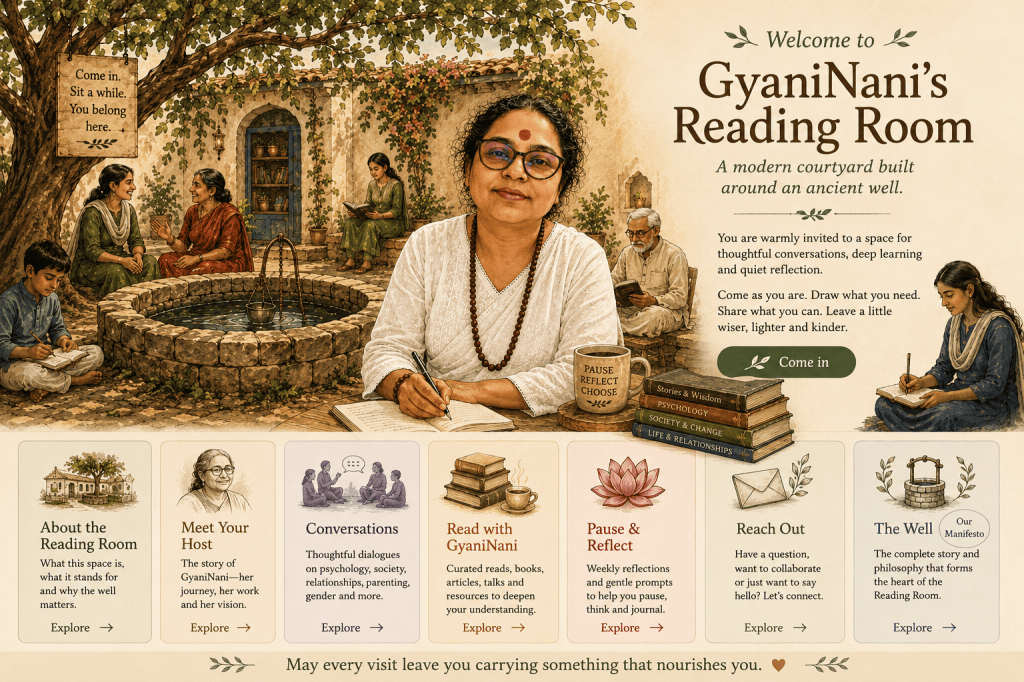
    Opening the Doors to the GyaniNani Reading Room

    1 July 2026

    “We believe that meaningful conversations can change the way we see ourselves, each other, and the world”

    Some dreams arrive quietly.

    Not with applause.
    Not with announcements.
    But with a feeling that refuses to leave.

    For years, I have written reports, research papers, evaluation studies, policy briefs and training manuals. My work has taken me into villages, schools, hospitals, old-age homes, juvenile homes, community centres and government institutions. It has introduced me to extraordinary people whose names may never appear in newspapers but whose courage has transformed the lives of others.

    Wherever I travelled, I returned carrying stories.

    Stories of women rebuilding their lives after violence.
    Stories of children searching for belonging.
    Stories of parents trying to understand their teenagers.
    Stories of farmers protecting seeds for future generations.
    Stories of widows discovering dignity again.
    Stories of hope that quietly survived in the most difficult places.

    I realised that behind every statistic I analysed, there was a human being waiting to be heard.

    Over time, another realisation emerged.

    The world does not suffer from a shortage of information.
    It suffers from a shortage of meaningful conversations.

    We have become skilled at speaking.
    Less skilled at listening.

    Quick to react.
    Slow to reflect.

    Certain of our opinions.
    Less curious about each other’s journeys.

    That is why this Reading Room exists.

    Not as another website.
    Not as another social media page.

    But as a place where conversations are allowed to breathe.

    Here we will explore psychology, parenting, gender, relationships, ageing, mental health, social change, purpose, grief, resilience and the many questions that quietly shape our lives.

    Sometimes the conversation will be with a clinical psychologist.

    Sometimes with a teacher.

    Sometimes with an artist.

    Sometimes with a social worker.

    Sometimes with someone whose voice is rarely heard.

    And sometimes, perhaps, it will simply be a conversation with ourselves.

    One of our first conversations, Beyond the “Trust Fund Kid,” reminded me that before asking what young people are using, perhaps we should ask what they are missing. That single shift—from judgment to curiosity—is the spirit in which this Reading Room has been created.

    I do not promise answers to every question.

    I do promise thoughtful conversations.

    I hope this becomes a place where research meets compassion, where lived experience matters as much as evidence, and where disagreement is welcomed with respect rather than hostility.

    If even one conversation helps someone understand another human being with a little more kindness…
    If one parent pauses before judging…
    If one young person feels less alone…
    If one reader leaves with a question worth carrying…

    Then this Reading Room will have fulfilled its purpose.

    Thank you for walking through these doors.

    Take your time.

    Browse slowly.

    Read deeply.

    Question freely.

    Return often.

    Because wisdom is rarely found in hurried conclusions.
    More often, it grows quietly through conversation.

    The doors are open. Come right in.

    With warmth,

    Deepali Bhattacharya
    Founder, GyaniNani Reading Room

    If this conversation made you pause, it has already begun its work.

    -GyaniNani Reading Room